Archive for February, 2011
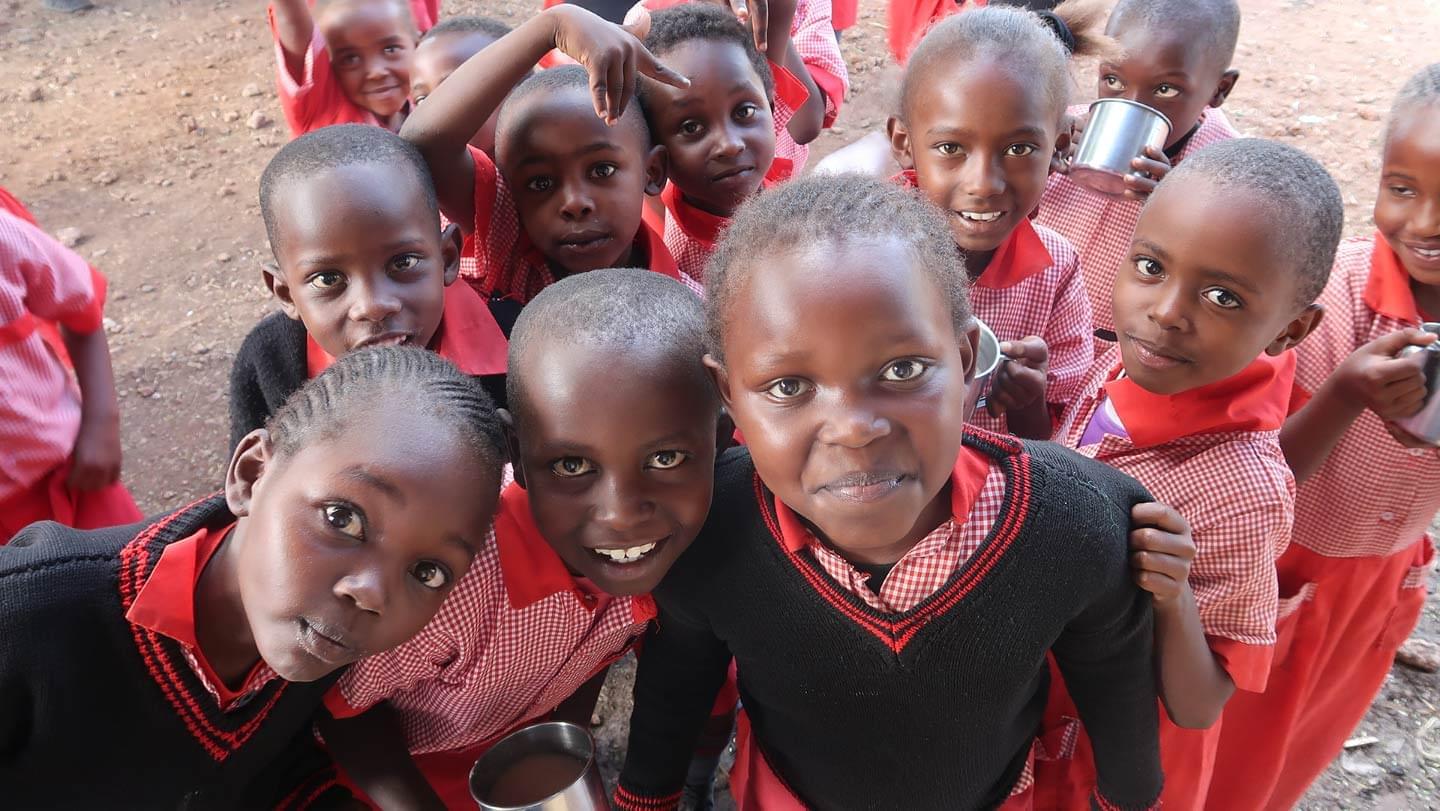
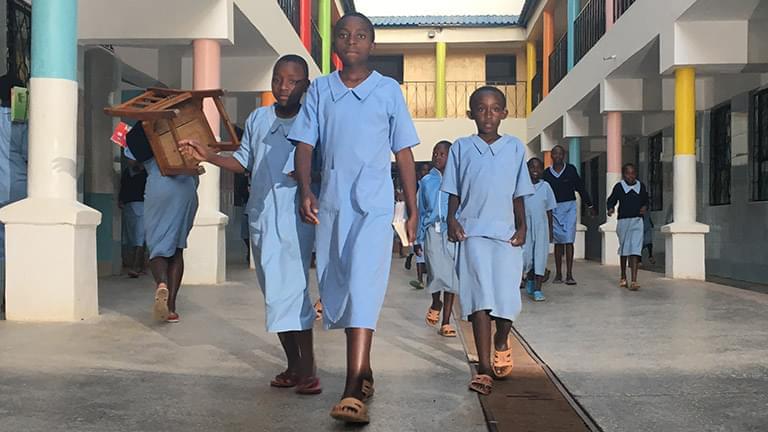
The four Dominican sisters who arrived last October are working closely with Madam Edna and Madam Sarah. Madam Sarah is in charge of the material administration of St. Clare and Madam Edna is in charge of the curriculum and the educational component. Together with the sisters they are a powerful team who provide love and direction to the 350 girls at St. Clare.
Sisters Renee, Christa, Kasthryn and Maureen pictured here with the children.
Beatrice, a high school student at St. Clare relects on amaranth which Fr. Riwa grows at the Children’s Village to supplement the diet of the children.
Amaranth is a plant grown in Kenya by international farmers; it also grows as a weed. The seed is as small as a mustard seed but when it is grown the yield is plentiful. When the amaranth is in the garden and still young the leaves are used as vegetables. It tastes very sweet and makes a delicious food.
When most of the leaves have been eaten as vegetables and others have withered, the seeds are harvested and dried properly. After drying, they are separated from the chaff and then the clear seeds are packed ready to be used as food. These seeds can be cooked nicely together with rice. They can also be taken to the posho mill and ground into flour that is used in cooking ugali, porridge and bread.
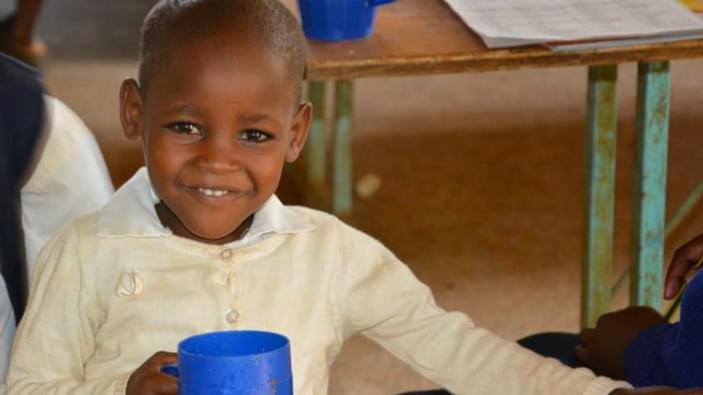
The amaranth promotes good health since when taken, it helps in the growth of strong bones for the young children. The children who are used to eating it will never suffer some diseases like rickets and kwashiorkor. Amaranth also causes the skin to become very beautiful and smooth. You don’t need to smear oil on your face if you eat amaranth. This is why all St. Clare girls are always shining like stars. If you see them you could think that they are fed every hour! But they have only three meals. That is, breakfast (amaranth bread and porridge), lunch (amaranth mixed with rice) and supper, (amaranth ugali and beans).
If you want to be healthy and beautiful and avoid diseases ,if you don’t want to waste your money buying oil, plant amaranth. It is good for feeding children who are young for them to grow up strong and healthy. AMARANTH – the most delicious food ever eaten.
“Inaitwa”! TRY ME ONCE AND YOU WILL SEE A CHANGE!!!
ELEPHANTS IN THE EASTERN PROVINCE
BY IRENE
It was a cool, sunny afternoon and the journalism class of six girls from St. Clare together with their teacher Madam Lisa, and Sister Kathryn, a nun from the United States of America, were taking a walk to the nearby forest to watch the elephants. These are huge animals that live in the jungle.
African elephants are black in colour and huge in size and they weigh a lot of kilograms. The government has tried its best to provide security for the people living around the forest. In earlier years the elephants were always disturbing people and destroying their gardens and crops and sometimes also killed people. For this reason they posed a great danger to people. This did not go on for a long time since the government came up with a solution. It provided electrical fence that prevents the dangerous animals from attacking people.
Elephants live in large groups that are comprised of male and female elephants. They move together with their calves. While grazing, one male elephant guards the others to provide security for the grazing elephants. They eat grass and the leaves of trees. Elephants are classified as herbivores due to their mode of feeding.
Elephants mate to have calves. Their gestation period is one year and the female gives birth to a calf. The calf grows under the care of its mother and when it is old enough it becomes independent.
The existence of elephants has a great importance in our country. They attract tourists from all over the world and by so doing they bring foreign money which the government uses to boost the economy of the country. The elephants have tusks that are very valuable. Because of this ivory hunters kill them. The government has fought a big fight in order to protect the elephants. It has set laws on how to take care of wildlife, which are usually followed, and the lawbreakers are put in jail for hunting. Everyone should protect his/her country’s heritage.
After two weeks, it was time for the volunteers to say good bye and return to the States. The final day of the visit was great fun as the children said a musical “Farewell and Thanks” through song and dance.
Everyone joined in the festive farewell, from the little children to the high school girls. It was a wonderful time for all.
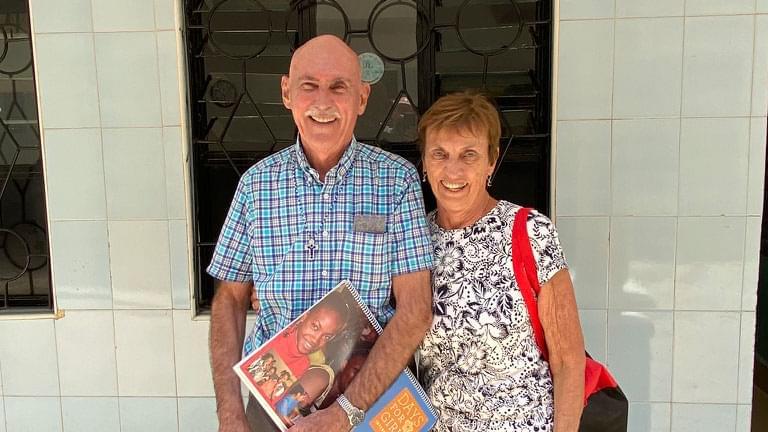
In January four women traveled wit
h us to Kenya.
They are pictured here with Bishop Mugambi, the bishop of the Diocese of Meru. The four women devoted their time to the Children’s Village who exposed the children to US history and geography, different approaches to math education and leadership training. A select group was given a short course on photo journalism. One of the volunteers is a bee keeper and she was able to offer training in bee keeping to women in the village as well as to a small group of interested children.
Building Kenyan Style is back breaking work. First the sand must be shoveled into a bucket on the ground, then pulled up three stories by a rope. The sand is then mixed with cement right on the floor. No cement mixers here. Just manual labor. As the cement is being readied, men are carrying up large stone blocks the three stories. These stones are put in place by the masons as fast as the cement and stones are can get there. This process goes on from early morning until darkness sets in. A long back breaking day.
Not all the boys can qualify for university studies. Some just aren’t students and others, after years on the streets cannot adapt to the rigors of student life. Francis is an example of this. Even though he was blessed with a generous and welcoming personality and even though he worked very hard at his studies, the studies always were difficult for him.
For these children Fr. Riwa has developed a Technical School of Masons. Besides classroom work in the skills necessary to be a quality brick and stone worker, the children also get ‘on the job training’ working on the sanitation block. Here is Francis putting a stone block in place.
Because everything in Kenya is built with stone, the young graduates of the School of Masons will find quality jobs for they are trained according to the standards of the European Union.