Archive for April, 2011
Tiny little trees play an important role in Kenyan construction. Hundreds of little trees spaced about a foot apart, hold up the forms in to which the cement will be poured. Hard to believe these little saplings can hold up so much weight but they do.
These trees also have a ‘second life’ for after the cement cures, the saplings are removed and used for fire wood to cook food for the children at the Children’s Village.
That is the good news. The bad news is the deforestation in Kenya due to this method of construction.
WHY THE HEN SCRACHES
By Agnes
The hen is a female chicken. It lays about twenty-five eggs a month. When she is setting she sleeps on them. After three weeks the chicks hatch. The hen is very attentive to her chicks.
Chicken eggs can be fried or boiled. Chicken meat is also food for human beings. The meat and eggs from the chicken are proteins. Proteins are important to our health.
Because of a great love of the human for their chickens, they build a small house known as “kisulhu” to protect them from being snatched by the vulture or the owl. Inside their kisulhu they are given the best food for them, which is grains, small insects and leftovers like ugali.
Clean water and hot “supu” is also put in a container for drinking. When the chicken is ill, the meat is not healthy for humans to eat. To avoid illness the kisulhu is kept very clean.
When the chickens are free to roam outside their kisulhu they scratch on the ground in search of food, or maybe something else. Wow, something else? The hen does not search for food only, but also for a razor! Oh, a hen looking for a razor? Does a hen know what a razor is? Does a hen have a brain like yours and mine? Well, maybe she has. There is a reason why she scratches the ground for a razor. The reason answers my question, “Why did a hen and a vulture become enemies?” Follow my pencils’ path and you shall know the truth.
Once upon a time the hen and the vulture were good friends. One day the hen saw that her chicks had shaggy hair and so she went to vulture and borrowed a razor to shave them. Vulture gave the razor to hen, instructing her to return it after shaving her children.
The hen departed and shaved her chicks. They shone on their heads and looked smart. Afterwards the hen kept the razor on the corner of the house. A few days passed without the hen returning the razor. When the vulture went for it, it was not found. The hen could not remember where she had put it.
The following day the vulture came again for his razor and again it was not found. So he said to the hen that if she did not get his razor, he would snatch her chick and fly with it and have it for food. He threatens that even up to today. This is the reason why the hen scratches on the ground – she is still looking for the razor.
Sister Renee is one of the four Adrian Dominican Sisters who went
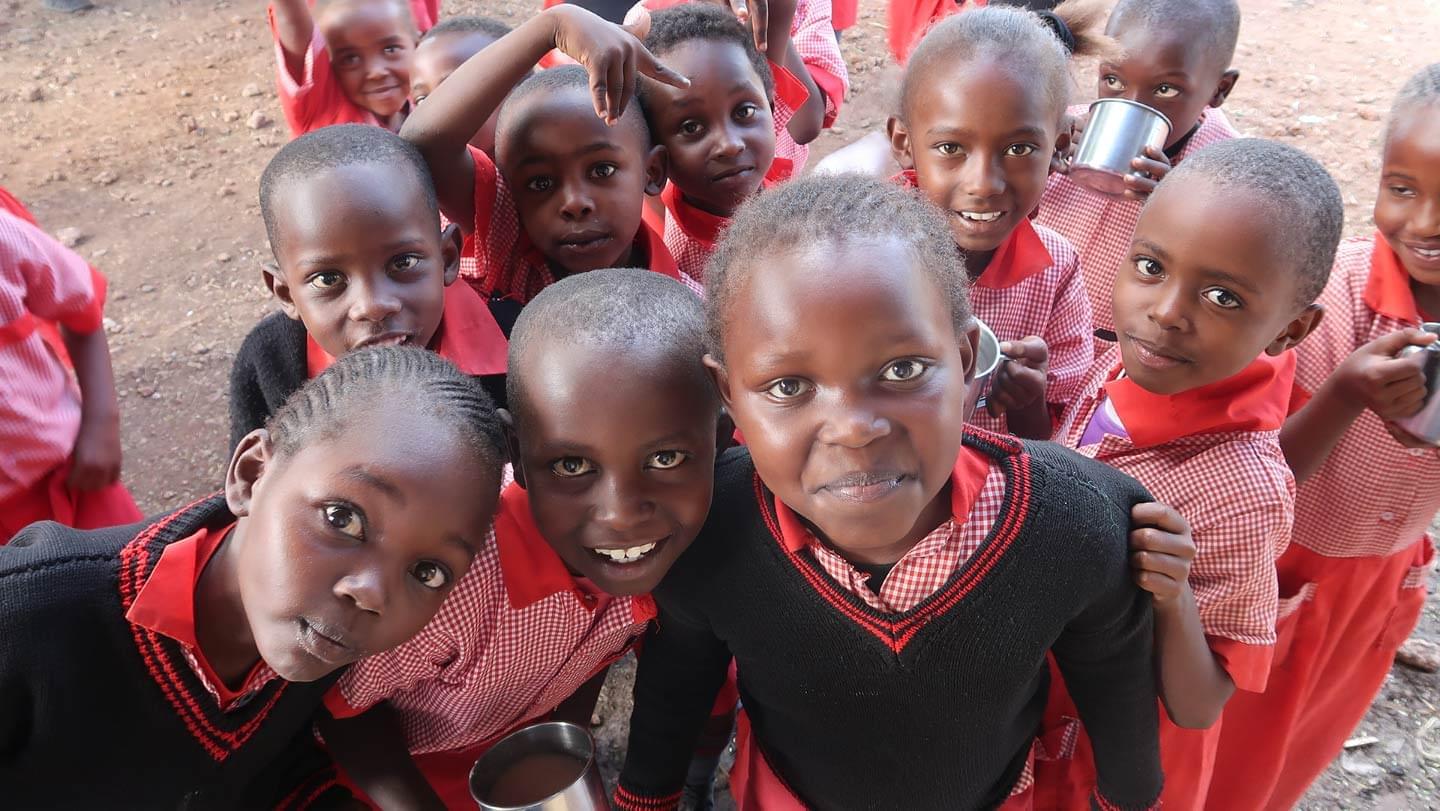
to Kenya last October to assist at the St. Clare Girls’ Centre. She is pictured her with some of the students.
Recently Sister Renee reflected on her first six months in Kenya. She wrote: “Father Riwa spoke so beautifully at Mass today. This is truly a holy place and we are blessed to be here. I can’t think of a better way to spend mylife. Hope all is well , Love, Renee”
Purity is a Form II (Sophomore) student and offers her reflections on the significance of the Siena House on the young girls at St. Clare.
DOMINICAN SISTERS CONVENT
BY PURITY
A convent is a house where a community of nuns (women members of a religious organization live and work).
The Dominican convent was started in August the year 2010 in Nchiru parish, Kenya. A missionary from Tanzania, called Father Riwa, who takes care of the street children and orphans, built it. When he started this project, he had no money but he had to make sure that the house was built because he really wanted the sisters from the U.S.A to come and direct the school as they teach girls good morals. We had to pray every day to get the money because we believe that God is the provider of everything and with God everything is possible.
Before Father went to America, he started the project and then left it to continue because he had faith that he would get the money to pay the workers after he was back. He stayed in America for one month and when he came back to Kenya he had enough money to pay the workers. This tells us that people in the U.S. A. are kind and generous.
The house was built and within five months everything was finished. As we believe in the pillar of prayer, we had to thank the Almighty God for the good convent.
In the month of December 2010 the house was ready and every requirement of the house was there. Our four beloved sisters transferred from where they were lodging in Meru to their new house. We were glad to see them in our presence. The house looks very smart and admirable. The St. Clare children like going near it to take their photos as the pictures normally come out smartly.
Now our sisters have planted some flowers in front of the house and it looks more attractive. They are smart sisters and are hardworking as they work day and night to see us succeed and become the future women of Kenya.
The sisters are happy to be with us here at St. Clare and we love them very much. They are planning great things for us girls. We are really blessed to have such sisters. I would be very happy to see Kenya with many nuns doing the work of God and spreading the Word of God to those who don’t know who He is.
What does this story teach us? Not that I actually wanted to say that the Dominican convent is built in Nchiru parish, but rather the message is: In whatever you do, you should have faith knowing that God has a purpose for each and everyone and He never lets the hardworking people down. The sisters said “yes” when God called them to St. Clare Girls’ Center.
We should always think about other people and be ready to serve them. The hands that give are more blessed than those that receive. ALWAYS BE READY TO GIVE.
The children in this picture are standing around a plastic bucket. There is a plastic bucket for each child and it serves many purposes.
First is their “laundry bucket” in which they wash their clothes. But it iis also the “DOP Kit” in which they keep their toothbrush, soap, etc.. It is also the “cleaning bucket” they use to clean their assigned area of responsibility at St. Clare.
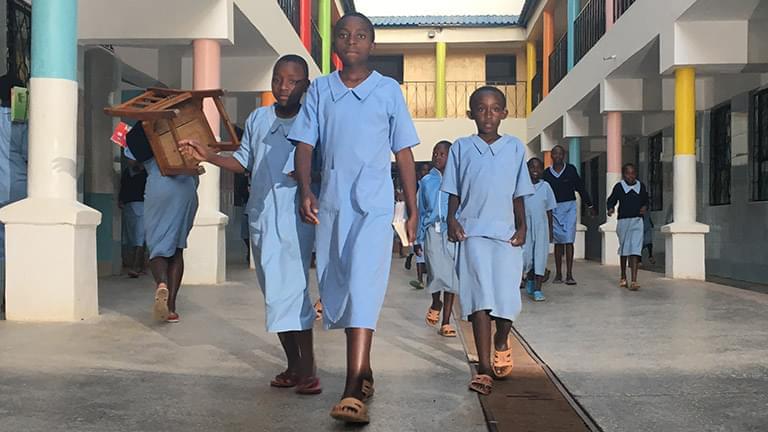
It also the “trash bucket” when they are told to go clean trash off the property as seen in the photo. However the favorite use is that of a drum for their dance and song. Just turn it upside down on the ground it transforms into an excellent drum.
Ah, the many uses for a plastic bucket!!!! The multipurpose implement. One tool, many purposes.
There is a lot of excitement surrounding the building of the sanitation block. The girls are constantly traveling up the steps to check on the progress of the construction.
Then, in the evening, when the workers are gone for the day, then the girls can inspect the work and take turns getting rides in the wheel barrow.
Did you ever wonder how you hold up a 6 inch cement roof while it is in the process of drying?? In Kenya they use SAPLINGS ….. lot of saplings.
First a wooden subfloor is put down and then rebar is threaded throughout the proposed area of the cement floor. Meanwhile, hundreds of freshly cut saplings are cut down and braced between the floor below and the proposed roof. Then cement is mixed, on the spot, and put into the forms.
The saplings are amazingly strong and placed only about 12 inches apart. Once the ceiling dries, the wood is removed and the saplings are then used as the firewood to cook the meals for the girls. Nothing is wasted.