Archive for May, 2011
The children at the Village realize education is their path to a successful future. They do not have a family network to save them. So education is very important to them. Nancy, a Form II student offers her reflections.
EDUCATION IN KENYA By Nancy
In Kenya there are two types of education, formal and informal. Informal education is tra
ditional education whereby people receive special teachings from their elders by word of mouth. They are instructed on how to behave as adults, warriors, future husbands and parents. They are also taught the secrets of their community. Formal education in Kenya is the modern way of learning in institutions of education. The curriculum follows the 8:4:4 system which means 8 years in primary level, 4 years in secondary level and 4 years in a college or university.
People in Kenya believe that education is the source of a successful life. So it is more valued and the more educationally advanced Kenyans speak three languages: English, Mother Tongue and Kiswahili. Kiswahili is a national language in Kenya. It is spoken in all of Kenya.
Most Kenyans nowadays learn practically. They believe that through education people are equipped to concepts and skills that are needed in solving the day-to-day problems of life. Education in Kenya aims at providing the Kenyans with necessary knowledge with which to control or change the environment for the benefit of the citizens.
Education in Kenya helps the Kenyan to develop careers. In order to develop careers, people are expected to work hard. Hard work is appreciated and valued in Kenya. People are encouraged to work extra hard through education and other works.
Lazy people are not welcomed in Kenyan society. This is demonstrated by a Swahili saying “Mgeni siku ya kwanza, ya pili mkaribishe y tatu mpe tembe.” Translated this means that people should not depend on others. If they need help from others they can be helped once or twice, but the third time they must work for it. So this expresses the value of hard work. It is emphasized that poverty is the consequence of laziness.
The Kenyans are taught to work very hard in order to fight and defeat the enemy, poverty. They really exercise their minds in thinking big and dreaming big with both words and actions. Through hard work Kenyans can transform the world and meet their basic needs at the same time. So what do you need in order to develop yourself and help to build your family and nation? You simply need to cultivate the virtue of hard work and become educated The role of education in Kenya’s everyday life has been made clearer by bringing out better understanding of the inter-relationship between Kenya and other countries. People of Kenya are encouraged to go to other countries, for instance the U.S.A., to extend their knowledge. A Kenyan who is not an educated citizen could be considered useless. No one will care for him/her since they do not work. The Bible says, “I will help those who help themselves.” The book of 2 Thessalonians 3:10 says that, “If you do not work you should not eat.” This is the philosophy of Kenya: if you are not working for your basic needs no one will provide them. So who is a loser? A loser is only the person who is not interested in participating in learning. Education is free in Kenya. The Kenyan government educates for free those who desire a better life. In other words, education in Kenya is the key to life.
The children at St. Gerard School in Lansing, Michigan decided to make the girls at St. Clare their special focus during Lent. Mrs. Kathy Partlow visited St. Clare in January and spent two weeks teaching at St. Clare as a visiting teacher. She brought back her experience to the children at St. Gerard and they responded.
The 7th, 6th and 5th grades raised over $600 .
One girl gave $50 which was her Christmas gift from her grandmother.
The first graders with their teacher, Sheila Iding, had a Lenten piggy bank in which they put their coins throughout Lent.
Thank you St. Gerard School.
Beatrice, a form II student reflects on Madam Edna, the head mistress of St. Clare.
A HARDWORKING LADY By BEATRICE
She is as wonderful a person who has ever worked at the Clare Girls’ Center. She is nice, humble, flexible, hardworking, intelligent, loving and persevering. Do you want to know who this person is? As we read in the Book Proverbs 22:1 “A good name is rather to be chosen than great riches.” Surely, she has earned a good name. She is Madam Edna, our Headmistress.
She has worked so hard for the St. Clare Girls to have a brighter future. She conducts all that includes teachers,
students and pupils in the school. The wonderful Edna can handle both boarding and conduct the school. In addition to that, she has lessons to teach in different classes.
She wakes up at 4:30 to prepare herself for the new day. She also wakes the senior girls at that time to prepare themselves. At five ‘clock the seniors go for preps as Md. Edna makes sure the children from nursery to class six, the junior ones have taken showers without making too much disturbing noise, dressed in clean clothes, put their dormitories in order and are in their classes by six o’clock.
When any one of us has a problem, we easily express it to her. Because she is a scientist she understands many things about life. She gives us advice encouraging us to work extra hard in our studies and in extra-curricular activities for a brighter future and to become good leaders of tomorrow. Madam Edna acts as our role model. We all wish to follow her good example. To be like her we have “to take the bull by the horns and to square the circle.” This can really make us to be like her in the future.
Really, we love and admire this wonderful lady. May Almighty God give her health of mind and body to continue serving his people. May she blow a hundred candles on this world. She is a good leader and a role model to all.
The drought which has gripped Kenya not only escalated food costs but destroyed crops in the field. . Food is scarce and even though the portions are cut down, what the children receive is healthy. To fight back Fr. Riwa took over the play fields of the children to plant amaranth. This plant gives a grain which is ground into flour and the leaves are served in the rice and maze. It is considered the most nutritious of all plants, full of vitamins and minerals. This is Fr. Riwa’s way of keeping the children healthy. Food is scarce and even though the portions are cut down, what they receive is healthy.
Sister Kathryn reported: “The Nation Newspaper, in the April 21 edition noted that Kenyans are paying 25% more for food – the rise noted from January 1 through April 20. A sample of food items listed included sugar up 27%, bread up 14%, maize (corn) flour up 24%, milk up 20%, tea leaves up 33%, rice up 10% and wheat flour up 38%.
Large crowds of people are starting to demonstrate in Nairobi and some of the larger cities about the rising costs of food and fuel making it impossible in many cases to feed their families. There seems to be considerable political unrest around this issue.”
A MAN BORN TO SERVE
By Ann
Imagine how good and how pleasant it is that Nchiru Parish in Meru was blessed to have a wonderful man such as Father Riwa for parish priest? This man is well known as a father of street (chokora) and orphaned children. According to many, he really fits as the father of nations (Abraham). How does this sound? Can you be a father/mother of so many? If you are determined and focused there will be nothing impossible through God.
When he came from Tanzania, he taught at Nkubu seminary. He visited many parts of Kenya. As he visited parts of Northern Kenya, children who were suffering and dying of hunger disturbed him. Can you even imagine the action he took? Did he give up because he had no money? No, he prayed hard and he had faith that God would open the way. It was not long before he started this mission of helping the Northern Kenya pastoralists’ children. He built schools for them, both primary and secondary. He stayed there for 10 years doing all manner of work to boost the economy of that area.
He visited other parts of the country such as Meru. As he came across Meru town he found how street children were suffering, stealing food or sometimes eating garbage and sleeping on the verandas outside the shops. How could he ignore this? Who would support him? Many questions kept lingering in his mind. Because he believed in prayers he did not worry. He spared no efforts to educate the children. He heard a call from God. The call was that he had to move from Northern Kenya to the Eastern Province. He obeyed the call. Everything that he had built in Northern Kenya he left under the care of the people in that area.When he transferred to Meru everything was in a mess; girls dropping out of school, children being mistreated and other children abused. He couldn’t bear this for long. He made very many friends through networking. He went on praying and after a month; he got some money with which he built the boys’ school, “St. Francis Children’s Village”. But before the building was completed, he used to sleep on a table and sometimes on the floor. Fr. Riwa and his children used to sit on the stones under a tree to have their meals. Can you imagine it? Not that he was poor but because he wanted to fulfill his parent’s request and also respond to God’s call. His parents asked him to help the aged and the children wherever he goes.
As days went on many boys came to get assistance from him. He neither rejected nor ignored anyone. A tireless and stalwart priest he knew that one day his dream would come true. He got people to contribute to his effort and others helped him in actual building. On the same school campus opposite the existing buildings, he built a secondary school for boys only, “Bishop Locati Memorial School”. It was named after Bishop Locati who had asked Father to go on serving the poor. The Bishop died in the same week he had given Father the advice.
Father Riwa was not comfortable because the girls were continuing to undergo a lot of difficulties. It is true that if you ask in faith, you will receive what you ask for. Within one to two months, he started the girls’ center, which is half a kilometer from the boys’ school. He started the girls’ center in 2006. It is a three-story building. Apart from the three schools mentioned above, he has also built a mason school at the boys’ village. He has built more than five schools in different parts of Meru. A father and mother of thousands of children, he is also the founder and the director of all of these institutions.
A missionary all the way from Tanzania to Kenya! Can you sacrifice your time or your life as he has? To date he still supports widows, orphans and the street children. I know that some people believe that this is impossible for one priest with little or no money. If you are among the people who doubt, come to Nchiru Parish in Meru, Kenya and see the wonders of God. A stanch Roman Catholic Priest, Father Riwa believes that with faith he can move the mountains of despair. He runs his schools with strict discipline, faith and love of God. Now his schools are known throughout the region because of their good progress. He is still struggling to make them provincially and nationally the best schools. The schools are built on four pillars, which are:
- Prayer – to God
- Study – hard for success
- Sports – for fitness
- Work – no laziness
Through living these four pillars many of his children have gone on to become doctors, nurses, judges and others who teach at university.
Father Riwa lives a very simple life. Both he and his children wear blue jeans, white blouses/shirts and navy blue pullovers. He believes in Romans 12:3 which states “for by the grace given to me I bid everyone among you not to think of himself more highly than he ought to think, but to think with sober judgment, each according to the measure of faith which God has assigned him.”
He is a very good role model for his children. This simple man sits under a mango tree whenever he has visitors because he does not have an office. He teaches us how to respond to God’s call. He left his country, family and parish in order to help and comfort the people in Meru. He sacrificed his personal comfort for God’s sake, but he will be satisfied. According to his teachings, he is a servant of God. He believes that his patron, St. Francis, intercedes for him. He tries to follow his patron’s footsteps. “SIMPLE LIVING, HIGH THINKING” are his principals. Those of us who know him believe that he is a very happy and peaceful and a successful man who was born to serve the needy.
Ann is the second from the left, bottom row, with her Form II classmates.
The Children’s Village is at full capacity but there are still hundreds of children living on the streets. Each week Fr. Riwa attempts to give them one “good” meal. This meal usually consists of bread and a carton of milk.
Fr. Riwa will tell one of the children the time and location of the feeding. It is usually late at night otherwise, due to the poverty in Kenya, many who are not street children would show up just to get some food.
Hundreds of orphaned street children show up and the process is amazingly orderly. When Fr. Riwa arrives he leads them in a grace before meals and then asks them all to sit down in rows and he distributes the food one at a time.
One volunteer said, “This is an incredible experience. I will never forget this moment.” Another volunteer noted, “I am surprised I am not afraid surrounded by all these street children, but with Fr. Riwa here, it is so peaceful and orderly.”
Sue Morgan, a California school teacher, visited St. Clare last year and noticed “they had a library room but very few books.” Morgan returned home to inspire the Glenview and Joaquin Miller Elementary Schools in Oakland CA to gather books “extra books at home” for the St. Clare library.
Morgan was thrilled with the results but saw a hurdle when she realized how much it would cost to ship the books. To solve this problem, she turned to Jeff Funk, Oakland operations manager for DHL, a company with a commitment to charitable contributions.
DHL liked the idea and agreed to cover the $1,500 in shipping costs. “It helped the morale of our people because it came out of Oakland and it fit our global initiative which is to Go Teach,” Funk said. “It was an opportunity to help spread some knowledge with a book drive and we felt we’d like to be a part of that.”
After the boxes were loaded on the truck, the children were told that the books would arrive in Kenya “in just two or three days.”
OUR YOUNGEST SISTER IN ST. CLARE GIRLS’ CENTER
BY AGNES
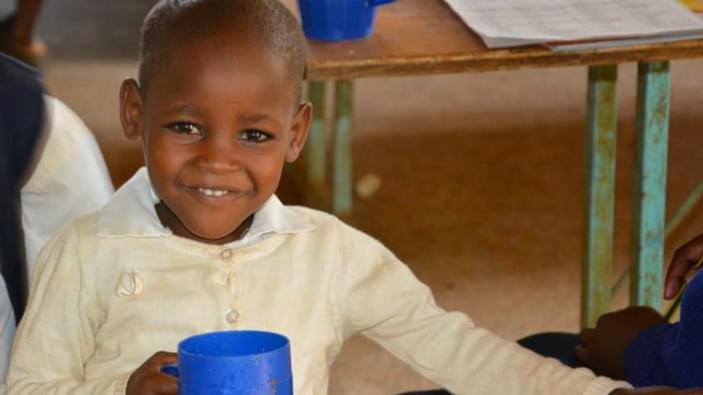
Have you ever seen a short girl like Zachaeus, who climbed a tree very fast like a monkey to see Jesus? She is the one at our center. Her name is Judy and she is five years old.
I hope those of you who are reading this story know the color of charcoal. Her hair is black in color like that of charcoal. It might be longer than yours or mine. On her two cheeks two dimples appear smartly while she is laughing. This one, our last-born is a rabbit (which means in our culture cleaver or fast in thinking.) Wow! She is brown like chocolate.
She likes to have a personal bag in which to put her raiment’s and ornaments, to avoid throwing them all over. She knows she will get into trouble if she is careless with her things and that headmistress does not entertain such nonsense. She must be an organized girl. She also likes to have a toy and some teddy bears to sleep with. Maybe they are cute and gentle to her. Who knows?
Judy has many friends at school who are a lot of fun to be with. This is why she enjoys it here so much. Her friends include Glory, Twili, and Pamela. Sometimes they enjoy playing hide and seek, her favorite game. Her class teacher, Madam Tabitha, takes are of her in class and likes to be with her. Judy respects Millicent, one of the older girls who is her raiment’s’ keeper (a raiment’s keeper is one who takes care of her clothing and does her laundry).
She is a nursery pupil at St. Clare Girls’ Center. It is located at Nchiru, Meru in the Eastern Province of Kenya. Even though it is “ushambni” (rural area) it is nonetheless beautiful with many classrooms, a well, a big water tank and enough toilets, a big dining hall with clean running water for washing hands before and after eating. There are three cooks who prepare porridge, lunch and mouth watering supper every day.
Finally, Judy wishes to be as famous and as rich as Father Limo Riwa, our director! I like her smiling face, and that is nearly always what I see. May God bless her and may she grow up with the same wonderful spirit that she has now.