Archive for June, 2012
Connecting the girls of St Clare with folks here in the U.S. is one of the biggest challenges Friends of Kenyan Orphans faces. However, our sponsorship program, initiated in 2010, does just this. In two years, we have created 125 relationships between young St Clare girls and donors in the U.S. and Canada. Through letter writing and photos and even reports on school progress, donors follow the growth of their young Kenyan girl. In return a sponsored girl develops a friendship with a caring, concerned new friend— a win/ win situation
Consider becoming a sponsor and become involved in this life-giving endeavor. For more information check the HOW YOU CAN HELP TAB on this web site.
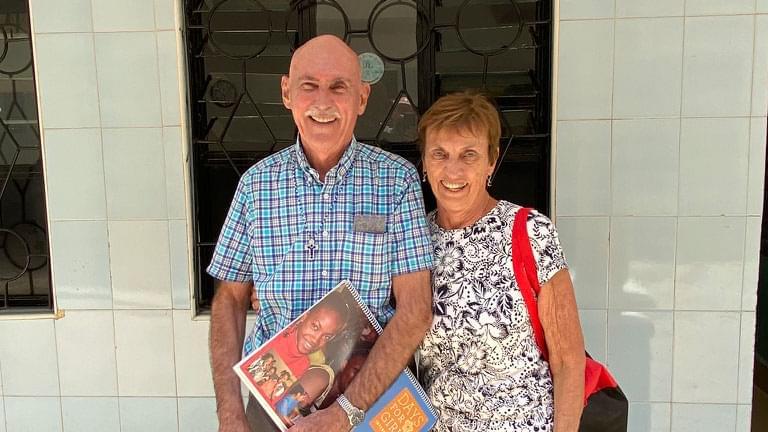
Pictured here are Jack Horrigan and Safarin. Jack has been sponsoring Safarin since january 2010 but met her for the first time during a visit to St Clare in February 2012.
Part of the first graduating class from St. Francis School in The Children’s Village was Joseph Mutuma. Joseph received a full tuition, room and board scholarship in 2008 from Chestnut Hill College in Philadelphia, Pennsylvania. In January 2009, Joseph began his undergraduate studies at Chestnut Hill. As a freshman, he was inducted into Alpha Lambda NHS for outstanding freshmen. In addition, he became a member of Sigma Beta Delta International Honor Society for Business Management and Administration. Further, Joseph is a Departmental Honors Invitee, currently investigating the Toyota Motor Corporation for his honors project. In addition to his studies, Joseph works on campus as a grounds’ keeper 20 hours a week and has also added computer science courses as part of his studies. Currently, Joseph is taking masters’ courses along with his undergraduate classes as part of a program, which allows students to take masters’ courses prior to receiving their undergraduate degree.
In May 2013, Joseph will be awarded a BS in Accounting and Computer Science and in December 2013, Joseph will be awarded an MS in Instructional Technology. Joseph’s professors, administrators, his supervisor on the grounds all rave about Joseph as an honest and hard working young man.
While Joseph’s accomplishments are notable, what is more impressive is Joseph’s background. His mother died when he was quite young and his father was unable to care for him. So, Joseph’s grandmother helped. Joseph lived with her for several years where they fetched water, grew a few potatoes for food, slept on a dirt floor. But Joseph’s grandmother was often ill. She died when he was around 5 years old; Joseph tried to survive alone. Someone in his village took pity and had Joseph move in with him. He was then sent to a primary school where he excelled. From here, Joseph found his way to Father Riwa. Joseph asked Father if he could stay and attend secondary school, which he did.
When she first met Joseph, Sue Ozar said he was beginning to learn the computer. But Joseph quickly learned to use the computer in connection with a brief English language course in Nairobi. From there Joseph traveled alone to Philadelphia to begin his studies. This is truly a remarkable story of an outstanding young man.

When Cathy Cahill visited St. Clare, hand washing became her goal. As a Nurse Practitioner, Cathy knows the need for and the positive outcomes of hand washing when it comes to preventing the spread of germs. “Of all the possible things I wanted to start there I decided hand washing would have the greatest health impact,” Cathy said.
Hand washing is not a common practice for most Africans as water is such a scarce commodity for so many. So when the children come to St. Clare the habit of washing their hands is foreign to them. Add to this, the girls share everything with their sisters plus it is very common to hold hands, even for men, when talking.
So Cathy spoke to each class and posted signs around the building. It was magic which caught on with the teachers and children. Now as the children line up to go into the dining hall, they must first wash their hands. To enforce this practice, there are signs posted to remind the girls and their teachers.
We need to take the fence down.
Can we get the tank up? Oh yes we can!
We’ll just roll it up the ladder! 
Andrew (in yellow hat) to the rescue 
The septic tank and pipes are in place to carry waste water from the building to the tank where it will be processed into grey water. However, the grey water must go somewhere and that is the next challenge. With Sister Kathryn supervising the construction of the drainage into two different fields and Mr. Steven A. Bennet from Texas generously donating the funds for the project, the septic system is well on the road to completion.
The first step involves connecting a holding tank for the grey water. You must remember that EVERYTHING in Kenya is done using manual labor. The photos below reveal the tremendous effort needed to raise this huge tank to the top of the platform. From this elevated position, the grey water will be carried by gravity to the drainage fields and supply nutrient rich water to the fields which supply much of the food for St. Clare.
Our next posting will be a photo collage (with comments) of the work it took to get the holding tank in place.
This is the final set of stories from the girls themselves. St. Clare Centre is home to girls from Meru, a city located in north central Kenya, and Nchiru, a small village near Meru,
Deborah (not her real name) age 14 has been in St Clare for 3 years. She came to St Clare from the Meru area where she was an orphan who lived with her grandmother, who also cared for several of Deborah’s siblings and cousins. “We were very poor so I seldom was able to go to school. Instead I stayed to help Grandmother with the other children by carrying wood and water. It was hard work. I wanted to go to school, but could not.” A neighbor who heard of St Clare from Father Riwa persuaded Deborah’s grandmother to allow Deborah to go to live at St Clare. Deborah continues,” I love school where I am learning and sharing ideas with the other girls. This is a loving community. Now I am in class 7 and doing quite well.” 
Ruth (not her real name)is 15 and one of the original students of St Clare. She came in 2006 from Nchiru where she lived with her grandmother. Ruth recalls,” My father died from being poisoned and my mother was sickly so my grandmother tried to care for me. In the beginning we were day students who returned home in the evening. We had no dining room and no classroom, so we ate and studied under the mango tree. I was grateful to be here at St Clare. Now my grandmother wants me to return to the village and be married. I want to stay here where I have my studies, my friends and I am safe.”
We continue our 5 part series of St. Clare girls telling their own stories. Our focus here is on Samburu (home to the Samburu people in north central Kenya) and Machakos (a city of poverty near Nairobi). 
Diana (her name has been changed) age 14 is from Samburu in Northern Kenya. She was orphaned at a very young age so she lived with her grandmother. They were very poor so they had little food and no money for school fees. As is the custom in Samburu, in order to secure a dowry of a few sheep and some sugar, Grandmother planned for Diana’s marriage. Her aunt intervened, said NO and arranged to bring Diana to St Clare. With great determination Diana continued “After my education at St Clare I want to be a nurse to help other girls BUT not in Samburu. I want to pick my own husband and not be told who to marry.” She concluded,” St Clare has saved my life” 
Nine year old Nancy (not her real name) comes from Machakos, an area south east of Nairobi. Although Nancy has parents and 6 brothers with whom she lived in Machakos, her father brought her to St Clare when she was 7 years old. Nancy NEVER returns to her home area to visit. If she were to go ‘home’ for even a few days Nancy would be forced to beg on the streets for something to eat. Some girls take shelter at St Clare to escape extreme poverty, with Nancy being one of these children. She appears to be exceptionally bright so with the care and good resources of St Clare she now has a chance for a future. 
Bud and Sue Ozar reflect on the incredible work that Father Riwa and the St. Clare Centre for Girls is doing “saving little girls’ lives.” St. Clare Centre provides food, a home and education for orphaned and abandoned Kenyan girls. Sue refers to St. Clare as “…a wonderful place providing safety and education for young women.”
We continue to hear two more stories from girls who left Eldoret in Western Kenya to come to the safety and security of St. Clare Centre.
Patricia (not her real name), age 12, is from Eldoret in western Kenya. When the post election violence of 2007 broke out, Sarah was told by her parents to stay in the house with her brother as there was fighting and killing happening right outside her home. The two children did as their parents said. Patricia explained “After that our parents disappeared and I never saw them again. I don’t know remember how it happened, but the next thing I knew I was in a hospital in Nanyuki in eastern Kenya. My grandmother was there. I lived with my grandmother for a few years, but we were so poor that there was no food for us. In 2011 I came to St Clare with some other girls from Eldoret. “ Bernadette reported, “I am doing well here and am very happy at St Clare.”
Bernadette (not her real name) is 15 and from Eldoret in western Kenya. Since her parents died when she was quite young, Bernadette lived with an uncle with whom she was living when the post election violence erupted in 2007. “My uncle and I were forced to move to the ‘tent area’ by the police for safety. For three years I lived in thiscamp. On many days we had no food. It was dirty and cold and I slept on a mat on the tent floor. I never went to school because school was only for the youngest children. It was a very sad life.” When Bernadette spoke of her life now at St Clare she lit up saying, “Now I am at St Clare where I have a good school, good food, good
friends and a wonderful life.” 
St Clare Girls Centre has also received several girls from Eldoret in western Kenya. Eldoret is home to several IDP (internally displaced persons) camps. Several girls from Eldoret shared their stories with me.
Teresa (not her real name) age 12 is from Eldoret in western Kenya. At a young age she was orphaned so Teresa lived with her sister and grandfather. They were very poor. So Teresa spent her days carrying water and tending sheep. When the post election violence of 2007 broke out, Teresa witnessed incredible destruction: homes were burned, people were beheaded and then burned to death. When she, her sister and grandfather escaped, they were taken by the police to a government camp for safety where Teresa lived for three years. She recalls, “I slept on a mattress with my sister. The place was very dirty. There were many people but never enough food. There were no good schools.” Father Riwa came to the government camp to bring several girls to St Clare. Teresa continues “Now I am St Clare, a very good school. I can learn here and there is enough food and I am never sick. I have many friends and I am very happy!”
Sarah (not her real name) is 11 years old. She too originally lived in Eldoret. During the post election violence of 2007 her mother and father were both burned to death in their home. Sarah remembers, “I ran away to a garden by myself and then went to my aunt’s house. My aunt was very poor so could not feed me much or prepare me for school but I helped out. Then I was brought to St Clare three years ago. I like St Clare very much, because they take good care of me and here I have friends and plenty to eat.”