Archive for November, 2010
In this photo you can see some of the girls from St. Clare visiting their former Samburu village. The thorny bushes in the background are used like barbed wire. It is woven together to keep wild animal out of the “boma” (compound) of the Samburu family.
Notice the difference between the St. Clare girls and the girls still in the at the Samburu village. This shows the contrast between the two villages. The Children’s Village, through education, offers the girls a wide open future in Kenya and the chance to go to the university. The future of the little girls still in the Samburu village is inscribed in their traditions. They will soon be married at 11 or 12 years of age, the 3rd or 4th wife of an old man, circumcised and doomed to taking care of the children of the other wives and tending to the livestock of her “husband.” WHAT A DIFFERENCE A VILLAGE MAKES!!!!!!
The Four Pillars of the Children’s Village are: PRAYER, STUDY, WORK AND SPORTS. Even though The Children’s Village is one, there are two different campuses: St. Francis for the boys and St. Clare for the girls. They are about a half mile apart.
The boys’ favorite exercise is jogging the two mile road several times a week as their main exercise to stay in shape. Each time it is a big competitive race leaving lots of room for male bragging rights (and bragging rites).
For their exercise program the girls prefer climbing Nchura Hill which is directly behind St. Clare. It is not an easy climb and takes several hours. But when they get to the top they feel like they have just climbed Mt. Everest.
But best of all, when you get to the top you can see for miles and miles. It is a great view.
There is always “one” who cannot resist the urge to wade through the water. It must be a universal thing between children and puddles. You just have to walk through them and even splash a bit. This little girl can always say: “I was just washing off my flip flops!” Notice how the other girls are enjoying every minute of this.
Fortunately, after it rains, the earth quickly swallows up the water, holding it to receive the seeds which Kenyans will plant in December. The mud on the surface is more slippery than ice. So it is navigated with great care, but can also make a great “slip and slide.” As you can see, the girls of St. Clare are not intimidated by the mud, just careful, as they traverse it on the way to the large field where they take their recreation.
It is easy to forget, Fr. Riwa is also a pastor of a parish and his parish church is dwarfed next to the St. Clare Centre. He built St. Clare right next to the parish church for that was the only property he had.
Because drought is in everyone’s experience, water has a special significance to Kenyans. The blessing of rain however can cause some problems getting in and out of the St. Clare building.
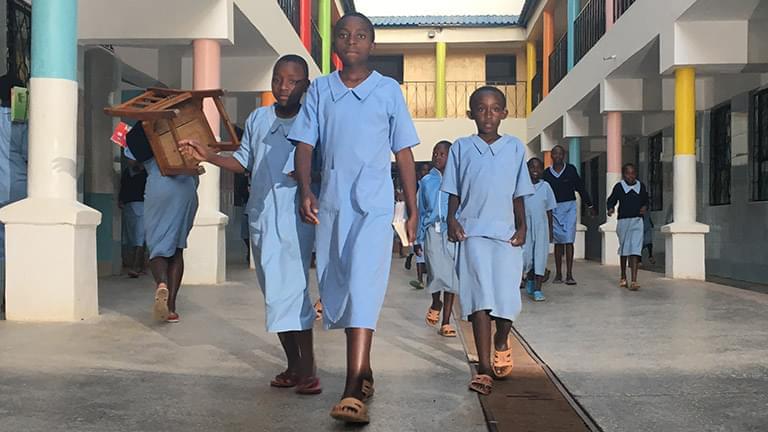
Here the girls are exiting on their way to recreation in the field next to St. Clare.
Fortuately, the earth will swallow up the rain in a few hours which presents a new challenge of MUD!!!
Drying clothing during the rainy seasons is another challenge for clothing is hung to dry outdoors and sometimes, if you are not attentive, your clothing will be almost dry and then the rains come up suddenly and re-washes your clothing for you. In the background you can see the children have hung their clothing on the railing to dry. Each girl has two sets of clothing and she is responsible for washing her own clothes.
Kenya ‘enjoys’ two rainy seasons. The loooooong rains come in October, November and December. During this period it rains most every day, all day. The short rains come in March and April and during this time it rains only at night. 
Every Kenyan will tell you “the rains are a blessing” for planting is done during the long rains and then as the vegetables begin to grow, along comes the short rains. These rains are critical because Kenyans don’t go to a supermarket to shop, they raise what they will eat on a small patch of land. If the rains don’t come, then the food does not grow and then hunger is everywhere. So rain is critical.
In this picture you can see the flood it causes at St. Clare. But the earth quickly absorbs this water and holds it in the ground to nurture new life. However, it does make it tricky and slippery trying negotiate and move around in it.
This photo was taken of the Class 8 girls after they finished the week long Kenyan National Exams. They spent months of intense study, now they will join all of Kenya awaiting for the publication of the results due in about a month from now, just before Christmas.![Class8 Exams[2]](http://www.friendsofkenyanorphans.org/wp-content/uploads/2010/11/Class8-Exams24-300x225.jpg)
Each year the Republic of Kenya conducts national standardized exams for children in grades 8 and 12. These exams are administered over a full week by the police and supervised by military armed guards to prevent cheating. The results are published on the front pages of the daily newspapers.
These exams are critical to a young person’s future for they determine which high schools will accept the grade 8 students and if the grade 12 students will be allowed into the university. If your scores are high enough, then the Republic of Kenya will award you university scholarship.
For the orphaned and abandoned children at the Children’s Village these exams are even more critical for they have no safety net. They must make it on their own. So, months of intense study and review fill their days prior to the actual exam days. If a Class 8 student at the Children’s Village scores exceptionally well, they might be given a full room and board scholarship to a prestigious Kenyan high school. If a grade 12 student does very well then he or she might receive a full scholarship to a university. That is their hope and why they study so hard.
Fr. Riwa is quick
to point out the children at the Children’s Village receive some of the highest scores in the district and most receive scholarships to universities or invitations from quality high schools. As Fr. Riwa brags: “Our former street urchins are now Kenya’s scholars!”
So if these girls look nervous, it is only because they are. So much rides on this. The pictures here were taken of the class 8 girls during and after their mathematics exam day.
Carol Kathambi relates the trip back from Samburu Game Park.
“We vanished from Samburu National Reserve and arrived in a place where there were Samburu manyatta (huts). Some warriors danced and others talked about their culture. WE walked around where they had some necklaces and traditional ornaments. It was very exciting to enter into their homes. The wall were dyed a brown colour. Finally we took our route back to school.”
People come from all over the world to visit Kenya’s game parks to see the wild life. Unfortunately, the ordinary Kenyan does not have the means to visit a game park. Because Fr. Riwa knows the managers of Samburu National Game Park he is able to reward the girls with a trip to the game park. Here is Carol Kathambi’s account of her trip.
“We had eagerly awaited this day. On the way we sang choruses and were all as happy as larks because we knew we were going to see good things and interesting sites and animals in the park. We saw a huge elephant running towards us. The driver drove the car very fast to get away.


![Girls in Mud[4]](http://www.friendsofkenyanorphans.org/wp-content/uploads/2010/11/Girls-in-Mud41-300x225.jpg)
![Class8 Exams1]](http://www.friendsofkenyanorphans.org/wp-content/uploads/2010/11/Class8-Exams1-300x225.jpg)